
Scientific Name
Other Names
Life Form
Family
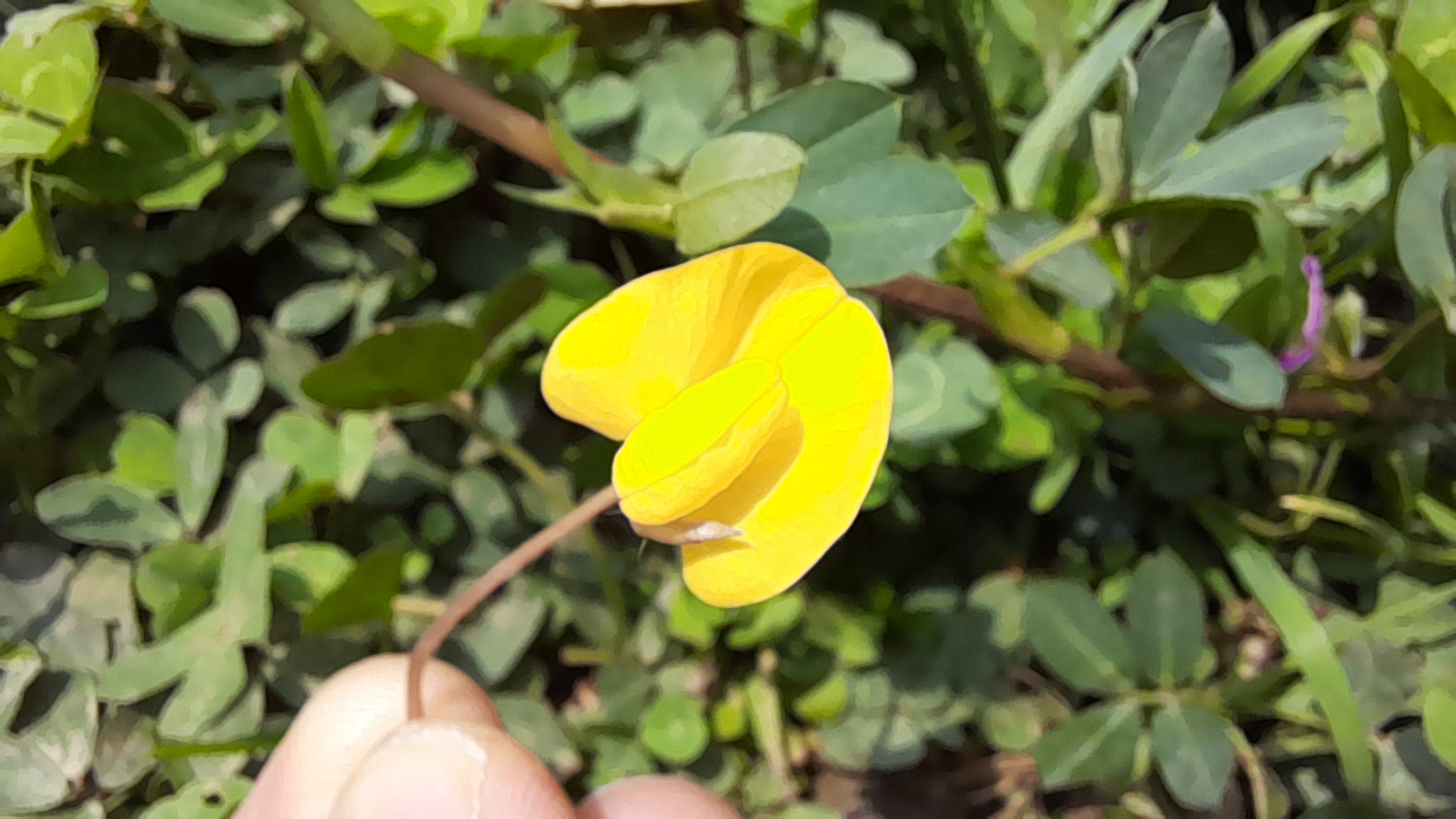
It is widely cultivated as high-quality forage and pasture legume, an excellent permanent ground cover for erosion control, and used ornamentally.
Native to South America (Eastern and Central Brazil). Widely distributed globally in tropical and subtropical regions.
Grows in humid tropical to subtropical environments, thriving in sandy loam soils of low fertility, and is highly tolerant of shade.

Stoloniferous, perennial creeping legume, forming a dense ground cover typically 20-50 cm high.
Stems are initially prostrate and form runners called stolons that creep along the ground, rooting at the nodes. The plant forms a dense, low-growing mat, with stems becoming slightly ascendant at the tips.
Leaves are distinctive, being tetrafoliolate (four leaflets per leaf). The leaflets are typically oblong-obovate, light to dark green, glabrous on the upper surface, and slightly pubescent underneath.
Flowers are zygomorphic (pea-shaped), bright lemon to golden yellow, and borne on short axillary racemes. Once pollinated, the flower stalks (pegs) elongate and grow downwards to penetrate the soil, a process called geocarpy.
The fruit is an underground, one-seeded pod (a small peanut), typically 1-1.5 cm long, produced on the pegs up to 7 cm deep in the soil. Pods contain a single, soft seed.
Flowering: Throughout the growing season in warm, moist conditions (often continuously).
Fruiting: Occurs after flowering, with pods developing underground.