
Scientific Name
Other Names
Life Form
Family
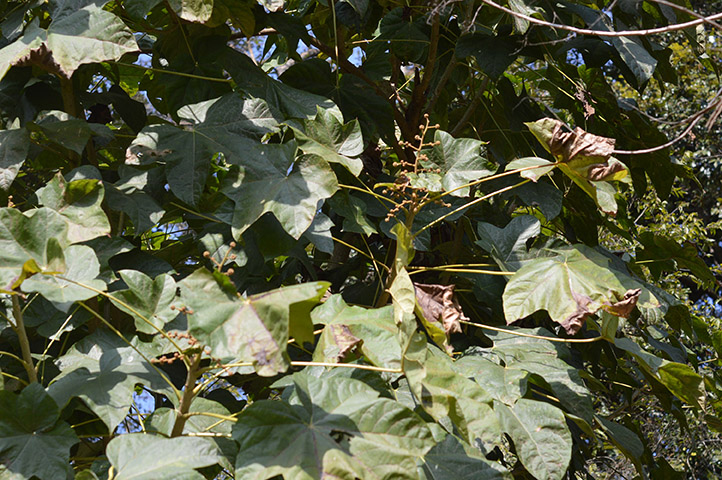
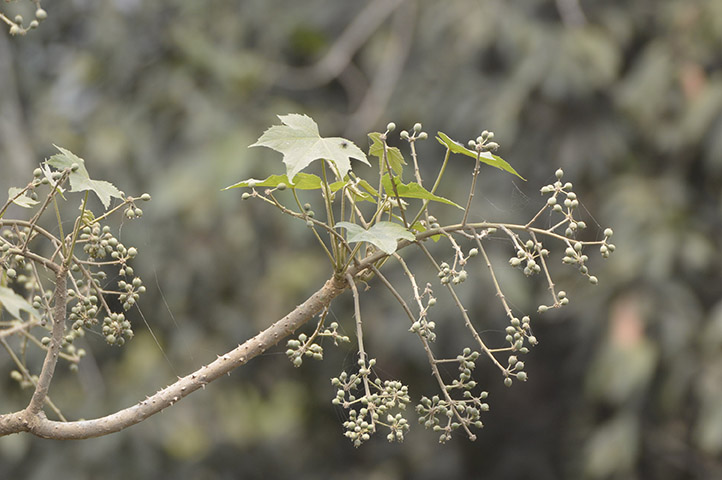
Ornamental - Brassaiopsis hainla is used as an ornamental plant in gardens. Medicine - It is also used for medicinal purposes, such as treating respiratory problems, skin diseases, and digestive issues.
Bangladesh, Bhutan, China, India, Myanmar, Nepal
Thrives particularly in monsoonal forests, prefers areas with well-drained soil, at an elevation of of 1300-2100 m.

It is magnificent tree upright growth habit reaches heights of up to 15 m. It's a hermaphroditic species meaning each tree has both male and female reproductive organs. It thrives in a single-stemmed form reaching towards the sky with its elegant branching structure.
Stem is a true standout. The sturdy trunk rises majestically, adorned with branches – they're armed with small, cone-shaped prickles.
Leaves are simple, 5-7-lobed; leaf-stalk 15-25 cm, woolly at first, becoming hairless. Leaves are 17-35 cm wide, papery, lobes divided less than 1/2 way to base, broadly ovate-triangular to nearly rounded, below velvet-hairy, becoming hairless, above woolly, veins prominent on both surfaces, base broadly convex, margin sharply toothed, tips tapering.
Flowers are clustered at the branch ends, forming dense clusters. Initially covered in a woolly material, these clusters lose their hairiness after blooming, revealing scattered prickles. The individual flowers are small and arranged in umbrella-like structures with a central stalk.
Fruit is nearly spherical and boast a persistent style, a remnant of the flower.
Flowering: December – March,
Fruiting: June – August.