
Scientific Name
Other Names
Life Form
Synonyms
Family
It is commonly used as an ornamental plant. Its therapeutic uses have also been listed, especially for analgesic and anti-inflammatory purposes.
Bhutan, China, India, Myanmar, Nepal
Warm, humid montane forests at 1,300-3,100 meters

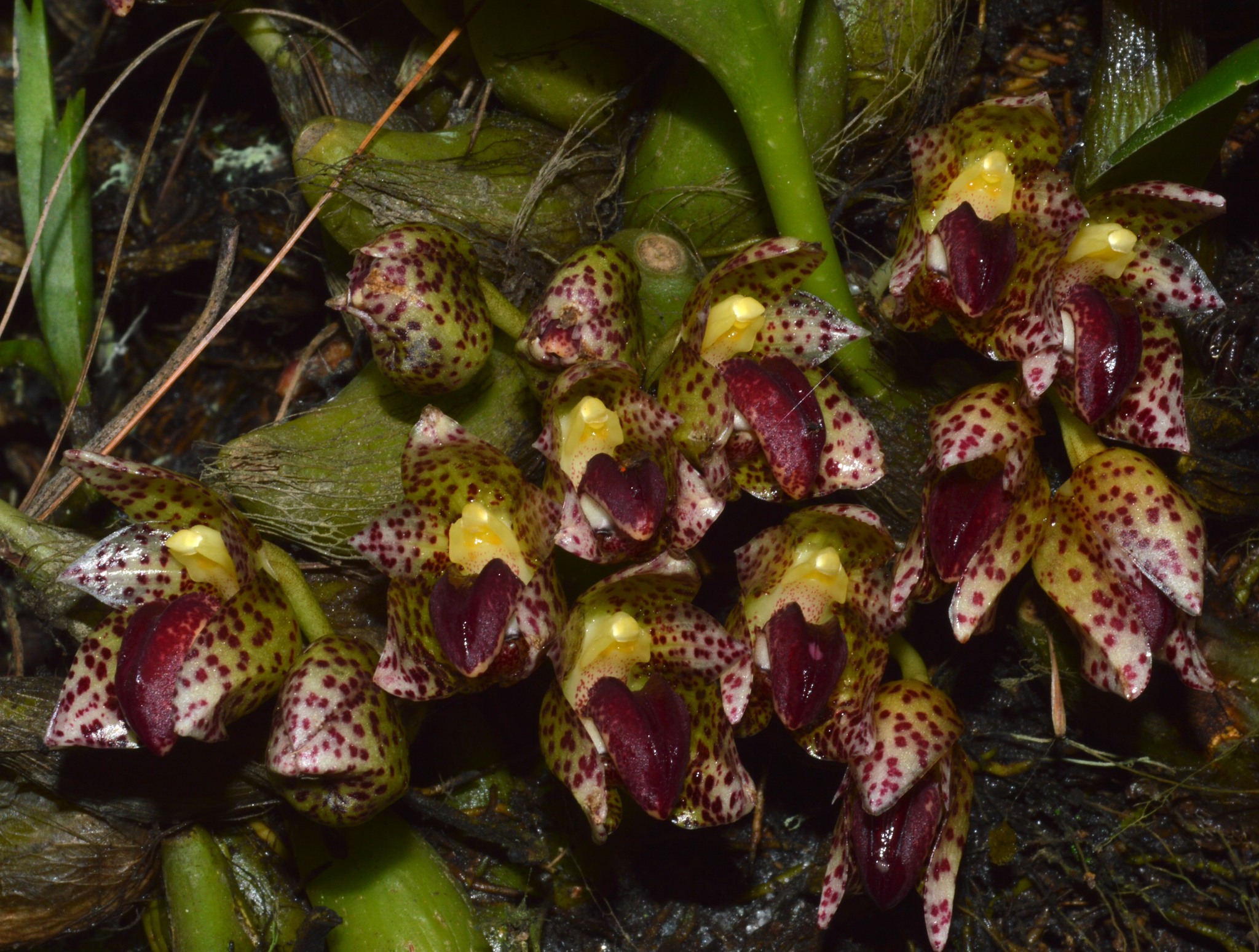
Small epiphytic orchid with yellowish flowers marked by dark spots, often growing on tree trunks or rocks in moist montane forests at 1,300–3,300 m.
Bulbophyllum leopardinum is a small- to medium-sized sympodial orchid, typically reaching 20-25 cm in height. The stem of the plant is divided into a creeping rhizome, which ranges from 2.5 to 8 mm in diameter, and distinct pseudobulbs. The pseudobulbs are ovoid, measuring 2-5.5 cm long and 1-2.5 cm wide, and are either close together or distant. Each pseudobulb bears a single, leathery leaf, which is elliptic to obovate in shape and can measure between 3.5 and 18 cm long and 2 to 6.5 cm wide, tapering into a stalked base of 2-8 cm. The plant flowers in the fall on a basal inflorescence. The inflorescence is an erect to spreading raceme, 5-10 cm long, that typically bears one to three resupinate flowers. The flowers are creamy yellow to pale green, often with spots or suffusions of red or purple, and a yellow lip. The dorsal sepal is prominent and elliptic to ovate-triangular (14-20 x 6.5-13.5 mm), while the petals are smaller (10-14 x 5-9 mm). The lip is fleshy, recurved, and hinged to the column. The fruit is a capsule, containing numerous tiny seeds.
Flowers usually appear in September–October, making it a striking species during the autumn bloom.