
Scientific Name
Other Names
Life Form
Family
Food - The pith of the stem is eaten as a vegetable. Medicine - The juice of the rhizome is used in the treatment of stomach disorders.
Bhutan, China, India, Nepal
It grows primarily in the temperate biome at mosit shady place at altitudes of 1000-2600 m asl.

While not typically edible, its pith is sometimes eaten as a vegetable. It is quite hardy and can tolerate cooler climates
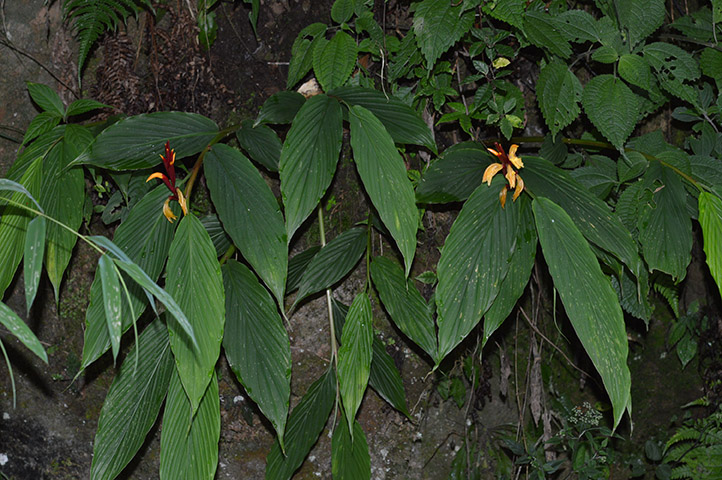
Perennial herbaceous plant that can grow up to 1 m tall.
Stems are actually "pseudostems" formed by the tightly wrapped bases or sheaths of leaves.
There are 4-7 leaves with a stalk 1.5-2 cm long between the sheath that forms part of the pseudostem and the blade which is free. The leaf blades are 12-30 mc long by 1.6-4 cm wide.
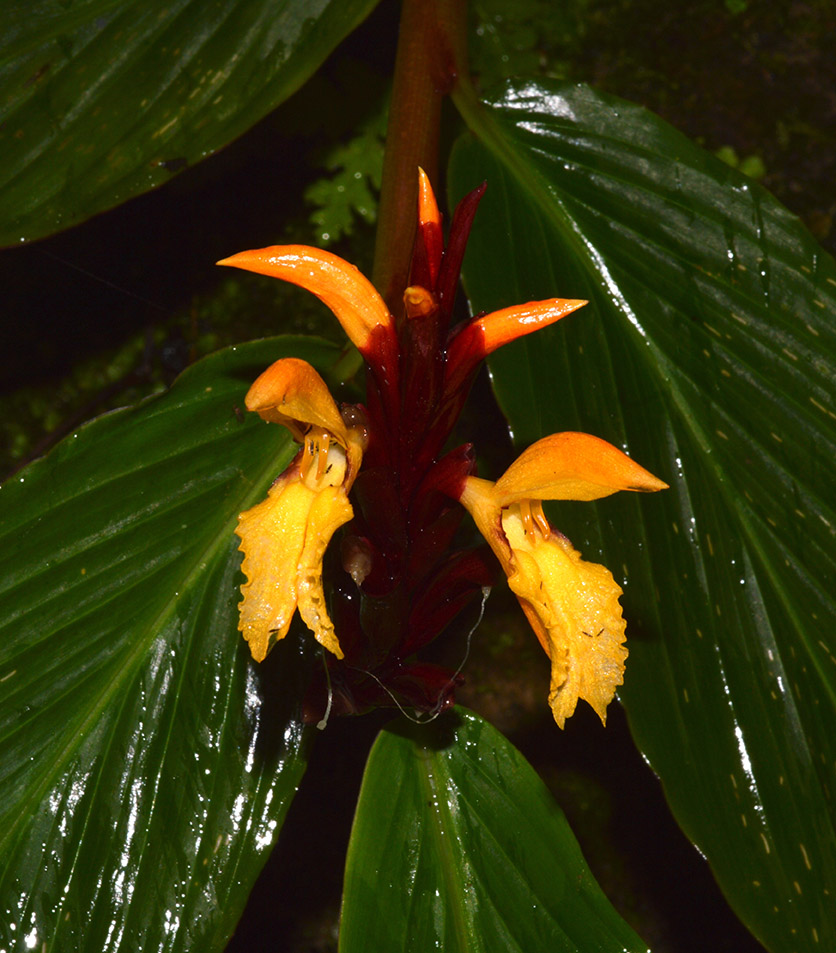
Flowers are yellow, few or many, crowded in an erect spike, 13-23 cm long. At the top of the stem. The yellow flowers ae covered with dark red bracts, as long as the sepal tube. The calys is shorter than the bract, being 1.5-2.5 cm long. Inside the calys, the three petals are fused at the base to form a tube about the same length as the calyx. At the end of the tube the petals form three lobes, 2-2.5 cm long.
Fruit is a capsule, ovoid to cylindrical in shape, with a waxy, grey appearance. It contains numerous black seeds embedded in a fleshy, orange-red aril.
Flowering: July-September