
Scientific Name
Other Names
Life Form
Family
Food- The tender young buds and leaves are boiled and then squeezed to lessen their bitterness. They are then prepared as a vegetable or pickle Medicine- The bark is antiperiodic, laxative, stomachic and tonic. The juice is taken in order to stimulate the appetite and to relieve stomach aches, It is also used to reduce the secretion of bile and phlegm, as well as to treat fevers and urinary complaints. Wood - Fuelwood: The wood is used for fuel. Wood - Construction: The wood is moderately hard. It is used for poles.
Bangladesh, Bhutan, China, India, Myanmar, Nepal
Thrives in mixed dry forests along streams. Prefers moist, well-drained soils in full sun to partial shade, at an elevation up to 1500 m.

It is deciduous tree with a wide-spreading crown reaching 5-10 m tall with some reports of specimens up to 30 m in exceptional cases.
Stem is with single trunk, grayish-brown, often hollow twigs that have sparse, whitish lenticels.
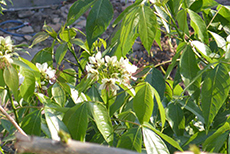
Leaves are compound with 3 leaflets. Each leaflet is elliptical, glossy, and subleathery, measuring 8-10 cm long and 3-4 cm wide. The underside dries gray, while the upper side dries to brown.
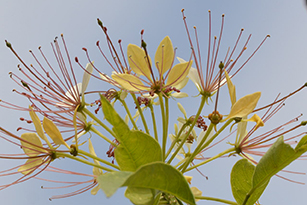
Flowers are white to creamy white (drying pinkish) with a prominent central cluster of stamens. Flowers appear in racemes or corymbs with 13 to 25 flowers per cluster. Individual flowers have petals with a 0.3-0.7cm claw and a 1.4-2.4 cm blade.
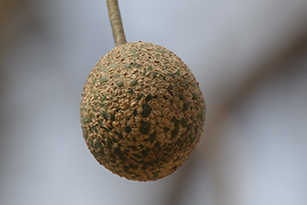
Fruit is globose (round) measuring 3-4 cm in diameter. The pericarp (fruit wall) is thick and has a rough surface with small, light yellow speckles. Fruit grow on a thick, woody stalk.
Flowering: March – July,
Fruiting: July – August.