
Scientific Name
Other Names
Life Form
Family
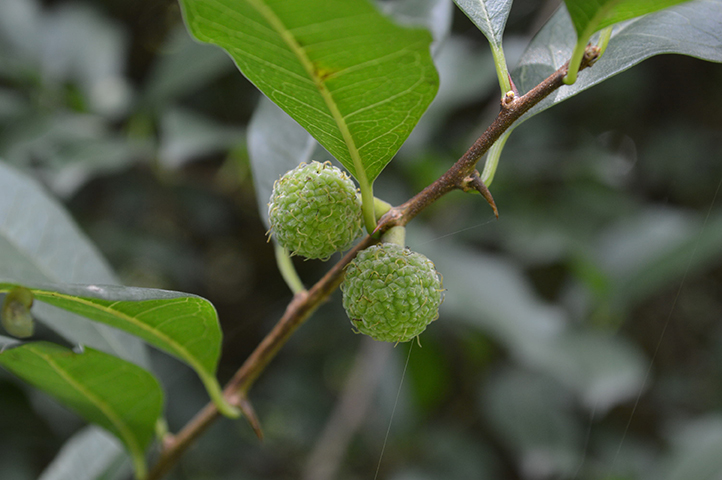
Food - The young leaves are sometimes eaten raw. The fruit is edible. Medicine- Fresh Leaves are Stripped of petioles, finely pounded, or made into a decoction for poultices to heal wounds in soft tissues. For penetrating wounds, poultices are applied on both sides and covered with a dressing. Poultices and dressings are changed daily. A decoction of roots is effective in treating Rheumatism, Oedema, Blood stasis, Dysmenorrhoea, Contusions and Coughing. Dye- The heartwood, particularly of the larger roots, but also of the stem, is used to dye textiles yellow in Indonesia, where it has long tradition of use as in batik.
Bangladesh, Bhutan, China, India, Myanmar, Nepal
Wet tropical biome.

Perennial climber
Woody, climbing with spines.
Simple, oblong to elliptic, with a short, pointed tip.
Small, inconspicuous, produced in dense heads.
Globular, yellow or orange, resembling a raspberry or mulberry in structure.
Flowering: April-May.