
Scientific Name
Other Names
Life Form
Synonyms
Family
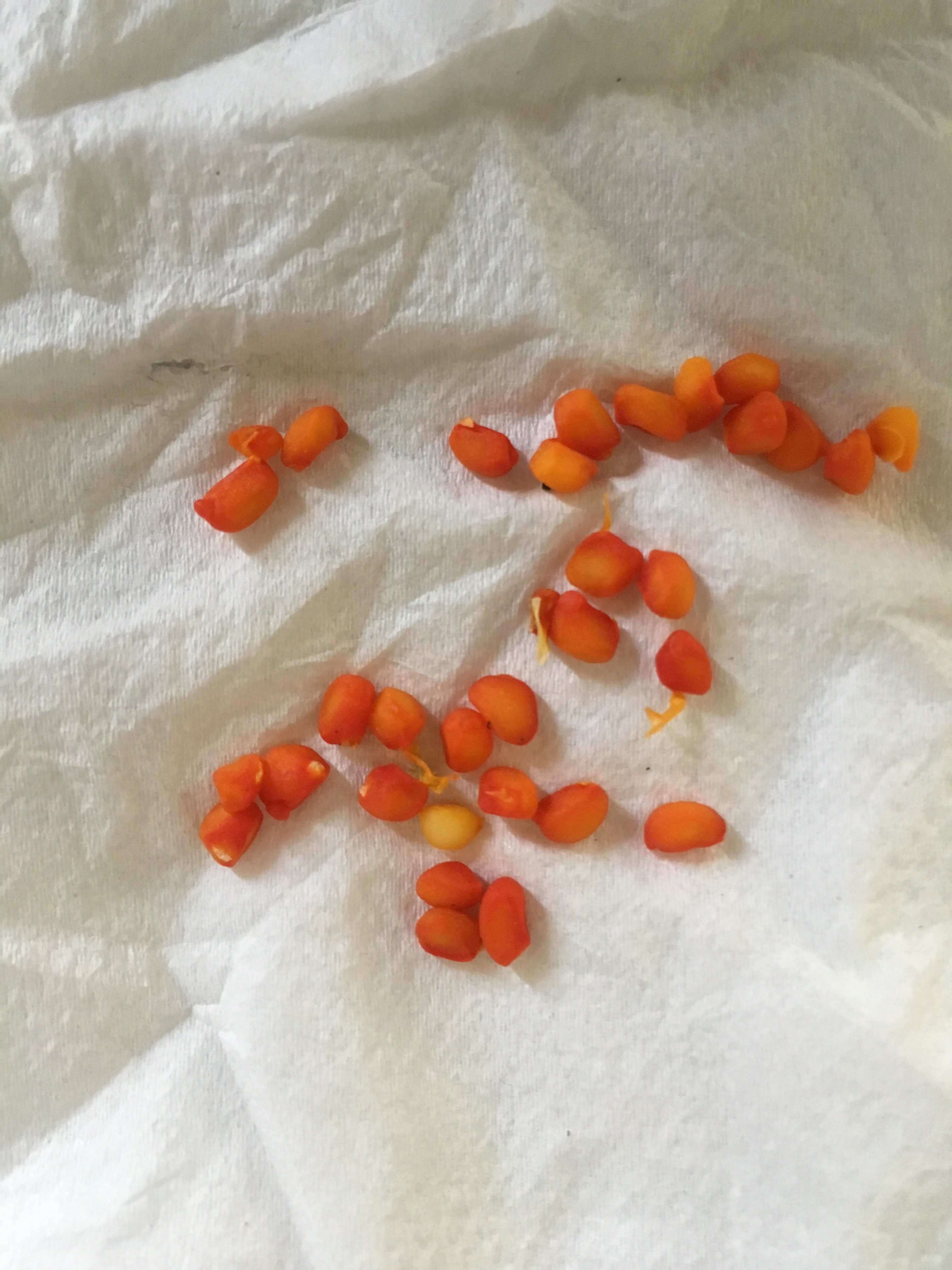
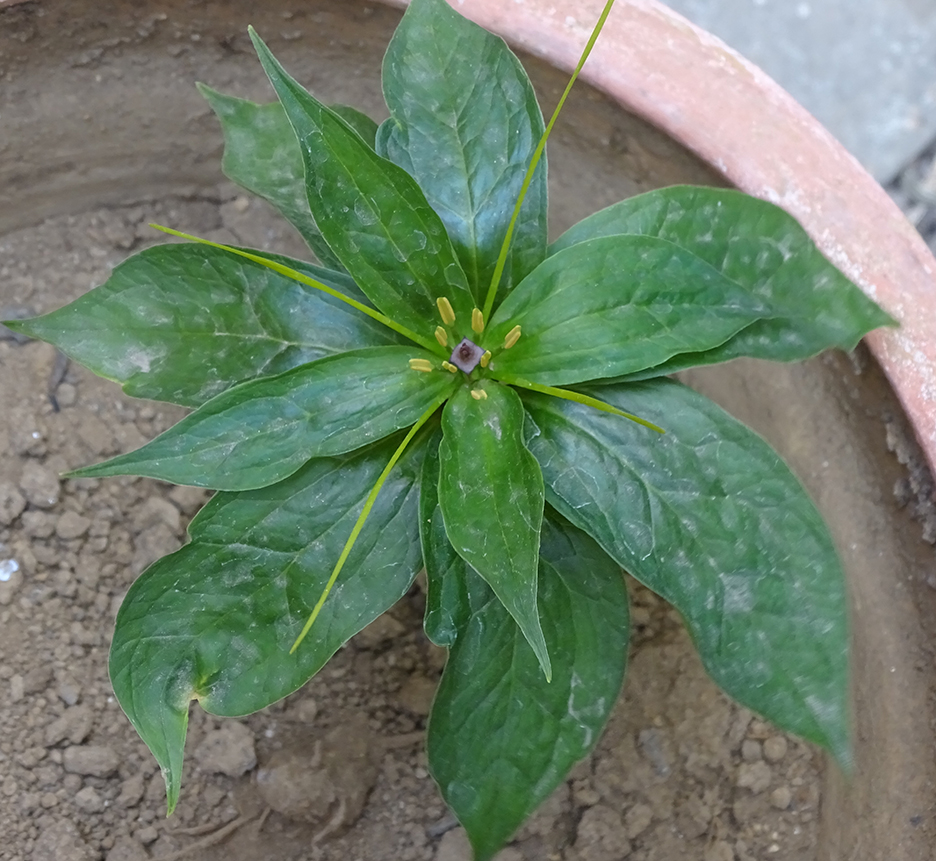
Medicine - The roots are analgesic, antiphlogistic, antipyretic, antispasmodic, antitussive, depurative, febrifuge and narcotic. Food - Seeds be taken in small quantities in Western Himalaya as a food supplement in dishes like puddings, and curries. Leaves are usually cooked as leafy vegetable saag and a traditional dish called kachru.
Bangladesh, Bhutan, China, India, Myanmar, Nepal
Broad-leaved and mixed woodlands to 3000 m

Also known as the Love Apple or Rhizome of Paris. Often over-harvested due to its high value. Used as a traditional remedy, particularly for treating snake bites.
Herbaceous perennial plant 10 - 100 cm tall.
Stem up to 50 cm tall, 3-6 mm thick.
Leaves 4-9; leaf 10.5-16.5 x 2.5-5.5 cm, lanceolate, glabrous, acuminate, venation reticulate; petiole short, 1-1.4 cm long.
Flower-solitary, terminal, pedicellate; pedicel 3.5-5.5 cm long. Outer perianth segments leaf-like, 5-10.2 x 1.3-3.3 cm, green, acuminate, venation reticulate; inner segments linear, usually shorter, 1-2 mm broad, yellow or yellowish-green. Stamens as many as the perianth segments; filaments flattened, 5-6 mm long; anthers basifixed, linear, 8-9 mm long, dehiscence longitudinal. Ovary sub-globose, incompletely 4-5-locular; styles 4-5, free to the base, tips curved; ovules many in each locule.
Fruit a fleshy capsule, sub-globose, c. 2.5 cm in diameter, 4-5-valved.
Flowering and Fruiting: March-November