
Scientific Name
Other Names
Life Form
Family
Medicine - Fruits and leaves are used in colic and bark in dysentery. It is also used in Chinese medicine to treat coughs, diarrhea, night sweats, dysentery and to stop intestinal and uterine bleeding.
Bangladesh, Bhutan, China, India, Myanmar, Nepal, Pakistan
Thrives in lowland, hill, and mountain forests, forests along streams, thickets, at an elevation of 100-2800 m.

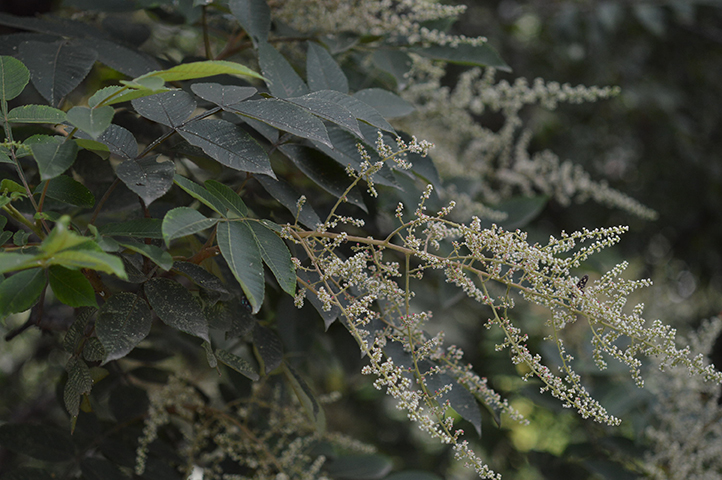
It is shrub or small tree deciduous spreading 2-10 m tall with branchlets rusty velvet-hairy warty.
Stem is often covered in fine, downy hairs, which can be a rusty-red or brownish color, particularly on new shoots. These hairs may diminish or disappear completely as the stem matures. The branching pattern is irregular, with branches arising at various angles from the main stem. The stem may also have small, light-colored lenticels.
Leaves are composed of 7 to 13 oval or oblong shaped leaflets. The edges are toothed and pointed at the tip. The top of the leaf is dark green with some hairs, while the underside is lighter green, hairy, and has a waxy coating.
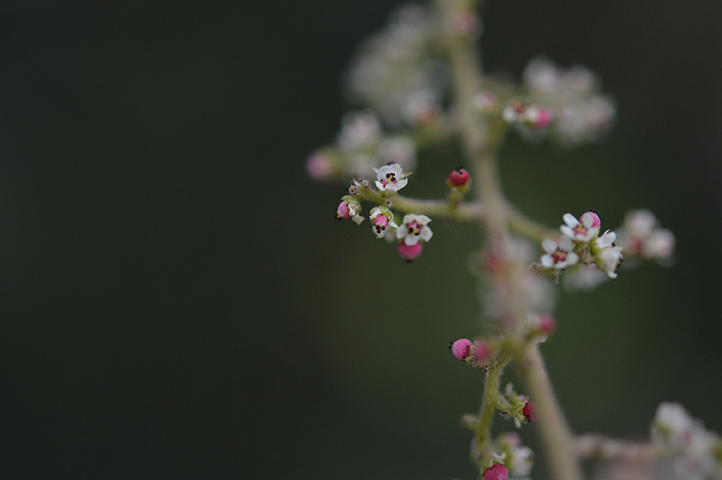
Flowers are borne in many branched clusters, densely rusty velvet-hairy. The male flowers are bigger, reaching 30-40 cm in length, and contain pollen for reproduction. The female flowers are slightly shorter and have the essential parts to produce seeds, including a hairy ovary with three styles. Both types of flowers have tiny, hairy stalks and fringed petal-like structures at the base (sepals).
Fruit is spherical, slightly compressed, mixed hairy and glandular-velvet-hairy, red at maturity.
Flowering: August – September,
Fruiting: October.