
Scientific Name
Other Names
Life Form
Synonyms
Family
Cultural/Religious - The flower stems are tied together and used as traditional brooms, whcih are used in various cultural occasions. Fodder - The leaves serve as green forage for livestock and are used as wrappers for glutinous rice dumplings. Eco-restoration - The plant's extensive root system helps prevent landslides and soil erosion on slopes. Additionally, the plant is grown as hedges (Huxley, 1992; Lin et al., 2019; Uphof, 1959).
Bangladesh, Bhutan, China, India, Myanmar, Nepal, Pakistan
Valleys and lightly shaded slopes; ravines; river banks; forest margins; open grasslands. Usually in association with trees (often bamboo forests), solitarily or in small groups, not in full sunlight at altitudes of 150-2000 m asl.

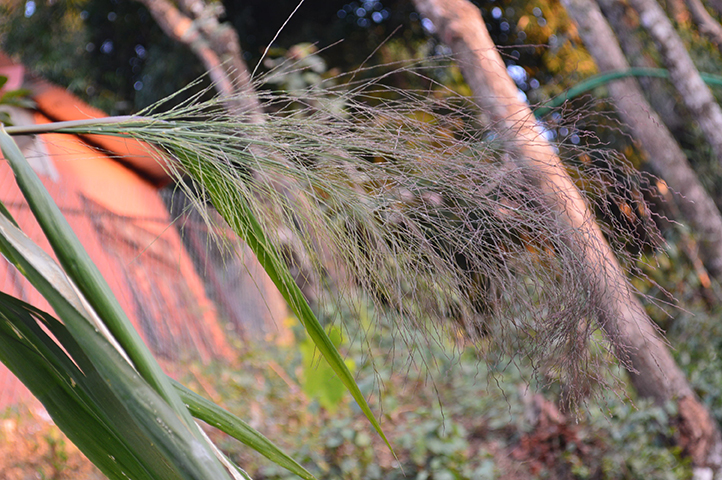
Also called "tassel grass" due to the appearance of its flower spikes. Is often used in broom-making and erosion control.
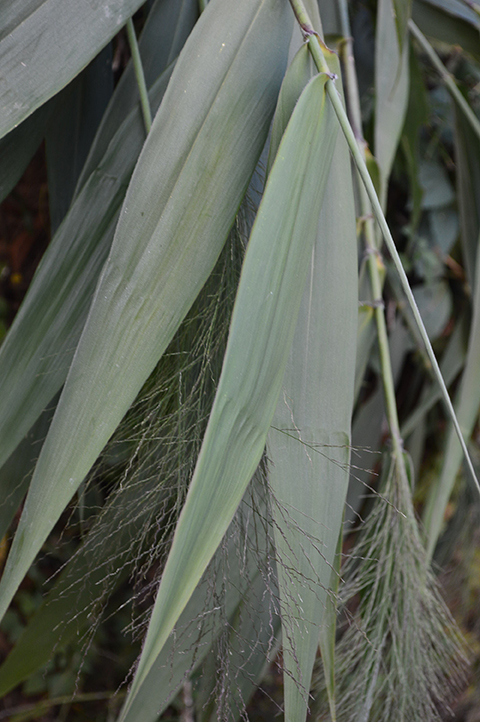
Bamboo like perennial grass, growing up to 2 m tall.
Stem solid and provides support for the tall, upright growth of the plant.
Leaf sheaths smooth; leaf blades broadly lanceolate-oblong, leathery, up to 40 × 3–7 cm; ligule truncate, 1–2 mm.
Flowers occur in minute spikelets, in large branched clusters. Spikelets 1.5–1.8 mm, ovate-lanceolate; lower lemma as long as spikelet; upper lemma slightly shorter than lower lemma, marginal hairs rigid, to 1 mm, spreading at maturity, apex slightly recurved. Anthers brown, 0.5–1 mm.
Caryopsis oblong, ca. 0.5 mm.
Flowering and Fruiting: July-September