
Scientific Name
Other Names
Life Form
Synonyms
Family
Medicine - The plant has antidote, antivinous, cholagogue, febrifuge, and ophthalmic properties. A yellow dye is obtained from the wood (Chopra et al., 1986; Duke and Ayensu, 1985).
Bangladesh, Bhutan, China, India, Myanmar, Nepal, Pakistan
It grows in mixed forests and shrubberies at altitude up to 2400 m asl.

Toxicodendron means "toxic tree", reflecting its potential to cause allergic reactions
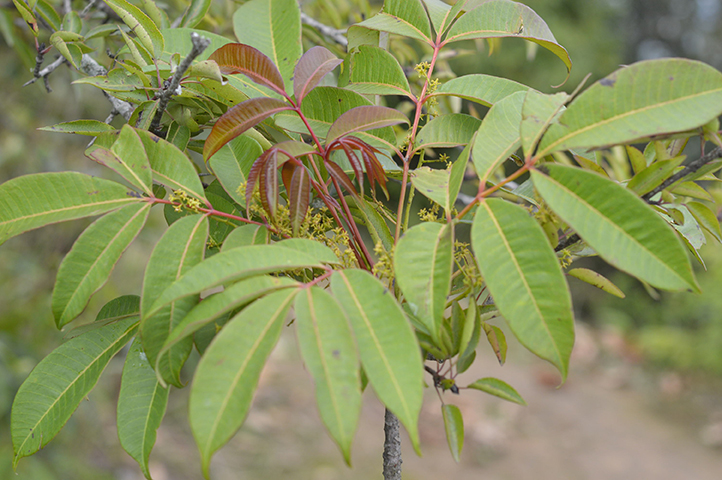
Deciduous shrub or small tree usually growing up to 7 m tall with occasional specimens to 15 m.
Bole can be up to 50 cm in diameter.
Petiole 6-9 cm, glabrous or pubescent; rachis terete or narrowly winged distally, glabrous to pubescent; leaf blade imparipinnately compound, 20-35 cm; leaflets 5-15, opposite or subopposite; leaflet petiolule indistinct or 2-5 mm; leaflet blade oblong-elliptic to ovate-lanceolate, 3-16 × 0.9-5.5 cm, papery or thinly leathery, glabrous to sparsely pubescent on both surfaces, glaucous abaxially, base oblique, rounded or broadly cuneate, margin entire, apex acuminate to caudate-acuminate, lateral veins 15-22 pairs, slightly prominent on both surfaces.
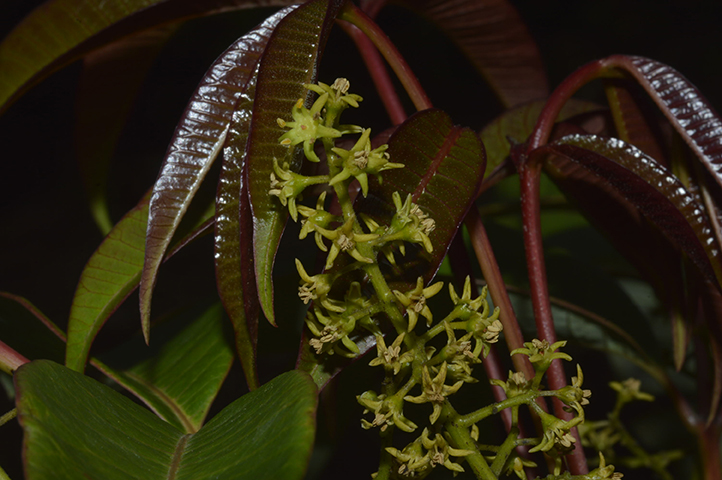
Inflorescence paniculate, 7-15 cm, many branched, glabrous. Pedicel ca. 2 mm; flowers yellowish green, ca. 2 mm in diam. Calyx glabrous, lobes broadly ovate, ca. 1 mm, obtuse apically. Petals oblong, ca. 2 mm, obtuse apically, with ± conspicuous featherlike venation pattern, revolute at anthesis. Stamens exserted; filaments linear, ca. 2 mm; anthers ovoid, ca. 1 mm. Disk 5-lobed. Ovary globose, glabrous.
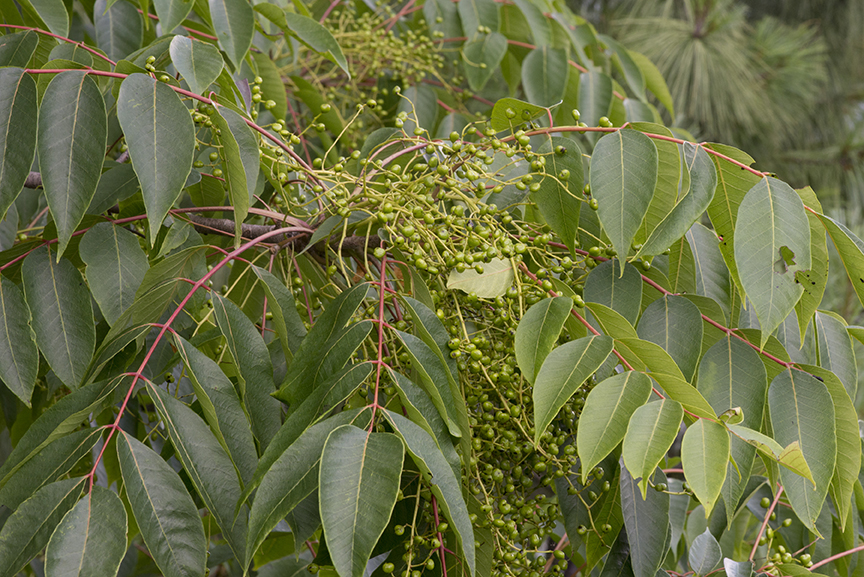
Drupe large, asymmetrical, 7-10 mm in diam., compressed, apex eccentric; epicarp thin, yellow, glabrous; mesocarp thick, white, waxy, with brown longitudinal resin ducts.
Flowering and Fruiting: January-December